Guide
Sleep Well Anywhere
Ten tips for sleeping better, backed by real evidence, from someone who has lived the problem and wanted real answers. Practical, portable, and built to work wherever you are.
Between us, Tim and I have slept in hundreds of different environments.
On the edge of an active volcano, in a yurt on a wooden bench, on a thin Thermarest in a tent for months at a time. On a yacht rolling enough to need one hand on the wall, on a hard park shelter bench with a storm raging around us, in hostel dorms with someone else's snoring three feet away.
And on the other end, in five-star hotels with the kind of bed that makes you wonder why you ever travel any other way, in luxury housesits where the bed alone was reason enough to be sad when the dates ran out, in resorts where the thread count should guarantee eight hours.
None of it made a consistent difference to how well I slept, not the rough nights and not the comfortable ones. Good sleep, it turns out, follows its own rules.
When we were younger that barely registered. A few rough nights wouldn't touch us. We'd just roll with whatever bed or non-bed we ended up with. That's not quite true anymore. A run of bad sleep hits differently now, and it takes longer to shake off than it used to.
After nearly two decades of moving between beds, tents and everything in between, it finally felt worth figuring out what the rules for consistently good sleep actually were.
My scientific background means I don't take wellness claims at face value. So I went looking for what the research actually says. These ten sleep habits are backed by real evidence and can travel with you wherever you go. Every factual claim in this guide is supported by published research. You'll find a full list of referenced sources at the end if you want to read the original studies.
I started digging into this properly because poor sleep, amongst other things, recently spiraled into a serious health event. I'm still traveling, and I'm starting to experience how powerful some of these strategies can be.
A Note on Real Life When Traveling
Most sleep advice doesn't hold up once you take away a stable routine. A fixed bedtime, the same room every night, full control over what's around you.
Keeping a stable routine is manageable when you're sleeping in the same bed every night with nowhere to be. It's harder when you've got a midnight bus to catch, or you're in a city where nothing starts before 10pm, or you're crossing time zones every few weeks and "consistent" simply isn't on the table.
Most of the ten tips below are doable no matter where you lay your head. I've laid them out in the order you'd actually use them on a normal evening, from the moment you stop eating right through to the last thing you do before you close your eyes.
If you miss one or two on a hard travel day, that's fine. Doing most of them, most days, should be enough to keep your sleep more regulated and help you get back on track after a rough night or two.
Why Sleep Is Harder on the Road, and Why It Gets Worse as You Age
There are a number of reasons good sleep is harder on the road. Firstly, there's something sleep researchers call the first-night effect. This is where part of your brain stays a little more alert than usual in an unfamiliar place, almost on watch. It's been measured directly in sleep labs, and it isn't just a one-time thing. It comes back every time you change location, which on a long trip means you might rarely get a proper recovery night. [9]
Then there's the stress that travel generates, even when it's fun. Flights, connections, accommodation, what to eat, where to go next, fifty small moving parts all needing to line up. Run that around in your head right before bed and your body responds the same way it does to any other source of pressure. Psychological stress raises cortisol and adrenaline, and both work directly against your ability to relax and fall asleep. [23]
The bed itself is another factor. Many Asian countries favor genuinely firm mattresses, rooted in tradition and a long-held belief that they're better for posture and back health. [24] If you're used to something softer, that firmness can feel like sleeping on concrete. The reverse is equally true. Someone accustomed to a firm bed their whole life can find a soft Western mattress just as disorienting. Neither is wrong. It's simply what you're used to, and sleeping outside that is its own quiet disruption.
And then there's temperature, with no way to control it. Sleep requires a fairly narrow comfortable temperature range, and research consistently shows that both extremes, too hot or too cold, fragment sleep and increase nocturnal awakenings. [25] Europe in summer without air conditioning is a common one for us. So is somewhere with heat rationing or power that only runs certain hours. It's not the heat or cold itself that wears you down. It's having no way to adjust it over a run of nights.
Finally, as we get older, most of us become a little more cautious in unfamiliar situations. Research on risk aversion shows older adults respond more strongly to uncertainty than younger ones do. [19] An unfamiliar room in an unfamiliar place is exactly that kind of uncertainty, and a quiet wariness is enough to keep part of your attention on alert right when your body wants to switch off.
None of this means anything's wrong with you. These are sensible instincts doing their job in a context they weren't built for, and understanding that is most of what you need to stop fighting it.
Ten Things to Do, in the Order You'd Do Them
This is the natural starting point for the evening, since everything else in this list happens after it. Eating closer to bedtime is associated with more nighttime awakenings and lower sleep efficiency, and the effect holds up across several studies. [20]
A heavy meal also raises your core body temperature right when you want it dropping, which works against several of the mechanisms further down this list.
Waking to use the bathroom is one of the most common things that breaks sleep apart, and it's one of the most preventable. Limiting fluids in the hours before bed, especially caffeine and alcohol, is a standard recommendation for reducing nighttime waking. [15] One study found fluid intake within two hours of bedtime was linked to lower sleep efficiency and more awakenings. [16]
I notice this most on our bicycle tours, where a campground bathroom can be 300 metres or more away across uneven ground in the dark. That's not a quick in-and-out. That's a proper wake-up, and it takes a while to settle again afterward.
Stopping it before it starts matters more to me than almost anything else on this list. Empty your bladder right before you get into bed regardless of how careful you've been.
A review of 17 studies on passive body heating found that a warm shower or bath, water around 40 to 42.5 degrees Celsius, taken one to two hours before bed significantly improved sleep onset speed and sleep quality. Benefits showed up from as little as 10 minutes. [3] The warm water raises skin temperature temporarily, and the drop afterward as you cool down signals the body it's time to sleep.
This is one I rate highly myself. Straight after the shower, while my skin's still slightly damp, I put on a generous amount of moisturizer, and that's noticeably cut down the nighttime itching that used to wake me.
I'll be honest though. A proper hot shower isn't a given in budget accommodation. Lukewarm or outright cold is more common than you'd probably like. On those nights, this one's simply off the table.
After your shower, as you're winding down, take a few minutes to put the day to rest. What got done. What you're grateful for. What you're looking forward to.
A controlled study found that fifteen minutes of this kind of writing before bed reduced worry and led to longer, higher-quality sleep. [21] A separate two-week study found the same pattern: faster sleep onset, longer duration, better quality. [22]
Gratitude gives your mind something else to focus on, so it doesn't spend those quiet pre-bed minutes replaying the day's worries or circling the same thought over and over.
Worth noting the limits. Most of this research relies on self-reported sleep quality rather than device tracking, and a fair amount was done with university students, not people our age. The pattern still shows up consistently enough that it's worth building into your routine.
The most rigorous trial to date, a randomized, double-blind, placebo-controlled study of 155 adults published in 2025, found magnesium bisglycinate produced a statistically significant but modest improvement in insomnia severity scores. [8] The effect was larger in people whose regular diet was already lower in magnesium, worth knowing if your eating gets erratic on the road.
Magnesium supplements are cheap and widely available. This isn't a dramatic fix. It's a small, evidence-backed nudge, not a sleep aid in the way a prescription medication would be.
For us it earns its place for a different reason too. Tim's prone to leg cramps at night, and magnesium is one of the things that genuinely helps prevent them. A proper cramp at 2am is a guaranteed way to wake you up and keep you up for a good while afterward.
Cheap, widely available, worth trying for a few weeks to see if it makes a difference for you specifically.
Blue light suppresses melatonin through a well-established pathway in the eye, and that suppression delays sleep onset. [6] The popular fixes are weaker than people assume. The evidence on blue-light glasses specifically is mixed. [7] Distance works better than a filter. Physically removing the temptation beats trying to resist it.
Some phones let you block social media, games and email between set hours while still allowing calls and texts through. I haven't fully worked out the safety trade-offs of that for solo travel yet, so take it as something to think about rather than a firm recommendation from me.
And if it goes flat overnight, that's not a problem either. No notification buzzing in the dark to pull you out of sleep.
Sounds odd, but it's one of the better-studied sleep tips on this list. A physiology study found sleep onset was 7.5 minutes faster, total sleep time was 32 minutes longer, night wake-ups dropped, and sleep efficiency improved, all from warming the feet. [2]
Warm feet cause your blood vessels to widen and bring more blood to the surface of your skin, which lets heat escape from your body more efficiently. That drop in core temperature is one of the main signals your body uses to fall asleep.
In Vietnam I'd run the air conditioning down to about 23 degrees so I could snuggle properly under the quilt. The problem was rolling over in the night and a bare foot hitting the cold air. That would wake me every time. Wearing socks, sometimes tights too, made a huge difference. Pack a thin pair. They weigh nothing.
Consistent wake timing genuinely helps stabilize your circadian rhythm, and setting it now is the last practical task before you actually get into bed.
The honest travel version of this tip has to admit something most sleep guides skip. You can't hold a consistent wake time through a midnight bus, a 5am flight, or a string of overnight transit days. Trying to force it just creates more stress than it solves.
Set it early rather than late, to make the most of your day and get your sleep cycle sorted. See Tip 10. A missed day or two doesn't undo the rest.
New environments mean unfamiliar sounds and unpredictable light, and you can't count on blackout curtains being there. Earplugs and an eye mask travel light and solve both problems directly. Together they're the closest thing to a controlled sleep environment you can pack in your hand luggage.
Leaving the earplugs out means a poorer night's sleep. That's the honest trade-off between optimizing sleep and feeling safe in an unfamiliar place. It's a personal call, and one that's worth thinking about before you reach your destination rather than at midnight.
A single session of slow, paced breathing — around six breaths a minute with a slightly longer exhale than inhale — has been shown in controlled research to shorten sleep onset, reduce overnight wake-ups, and improve sleep efficiency compared to faster breathing or no intervention at all. [18] The longer exhale is what activates the calming side of your nervous system most strongly.
My wearable has a built-in three-minute relaxation breathing function, 18 rounds of paced inhale and exhale. I layer my own visualisation on top of the pacing. I count down from 10, picturing the numeral on the inhale and the word spelled out on the exhale.
At 1, I move through the rainbow the same way. The colour or something that colour on the inhale, the word spelled on the exhale. I double up on violet to make the round come out at 18. If I'm still awake, I repeat the sequence backwards, and occasionally a third time. I've never needed a fourth before drifting off. Early sleep from this is light, which is why being left undisturbed for a few minutes afterward matters for getting into proper deep or REM sleep.
The pacing itself is what's been studied. The counting and colours are simply what I use to stop my mind wandering.
Tip 10: Get Outside Within an Hour of Waking
There's nothing better than seeing a place wake up. A walk before the crowds arrive does two things at once. Real daylight hits your eyes within the first hour of waking, and movement gets your body going. A single 30-minute morning light exposure right after waking is enough to meaningfully shift your body clock into alignment, almost as effective as longer exposure protocols. [1]
This one's the trickiest to explain. Morning light doesn't calm anything down. It does the opposite, it sharpens your natural cortisol spike right after waking, which is supposed to happen and is what makes you feel alert.
The sleep benefit comes from a completely separate effect of the same light exposure. It resets your body clock, which sets the timing for melatonin to rise again that evening. Two different jobs, one for today's alertness, one for tonight's sleep, and they're not in conflict even though more cortisol sounds like a bad thing everywhere else in this guide.
My morning walks in Saigon became a daily ritual, out before the city properly woke up, and the difference was real. It won't always be possible. Early flights and transit days will get in the way sometimes. That's fine. Most days is enough.
Grounding: A Sheet or Mat While You Sleep or Sit
What the research says
Research suggests that physical contact with the earth's surface, or a product that replicates that connection indoors, may improve sleep by helping to normalize nighttime cortisol levels and bring them back into better alignment with your natural sleep cycle.
A pilot study found grounding during sleep reduced nighttime cortisol, with participants reporting better sleep, less pain and reduced stress after 8 weeks. [14] A 2025 randomized, double-blind, placebo-controlled study on grounding mats found similar results. [26]
What I did
Being the sceptic I am, I ran my own structured 30-night experiment, tracking sleep data, pain levels, energy, and more as I traveled across three different locations.
I didn't just want to read the research. I wanted to know whether it would make a difference for me, in real travel conditions, in real beds.
What I found
The results surprised me.
↑ Sleep quality score: baseline 76, up to 90 by the final period
↑ Total sleep: from under 7 hours a night to over 8
↑ Deep sleep: up 63% vs my pre-trial baseline
↓ Aches and pains: decreased throughout
I was sleeping better, longer and more peacefully, waking up fresher and with fewer aches, and that was despite all the usual environmental challenges that come with moving between beds and locations.
The products have earned their place in my pack. Both together weigh under 400 grams — light enough that the decision to carry them, after the improvement I got, is easy.
These are my results — not a guarantee of yours. But they were compelling enough to keep me using them, and I think grounding is genuinely worth investigating if poor sleep or aches and pains are taking the shine off your travels.
One caveat: grounding products only work if your outlet is properly earthed. This isn't an issue in most western countries, but it's worth a quick check before you pack them.
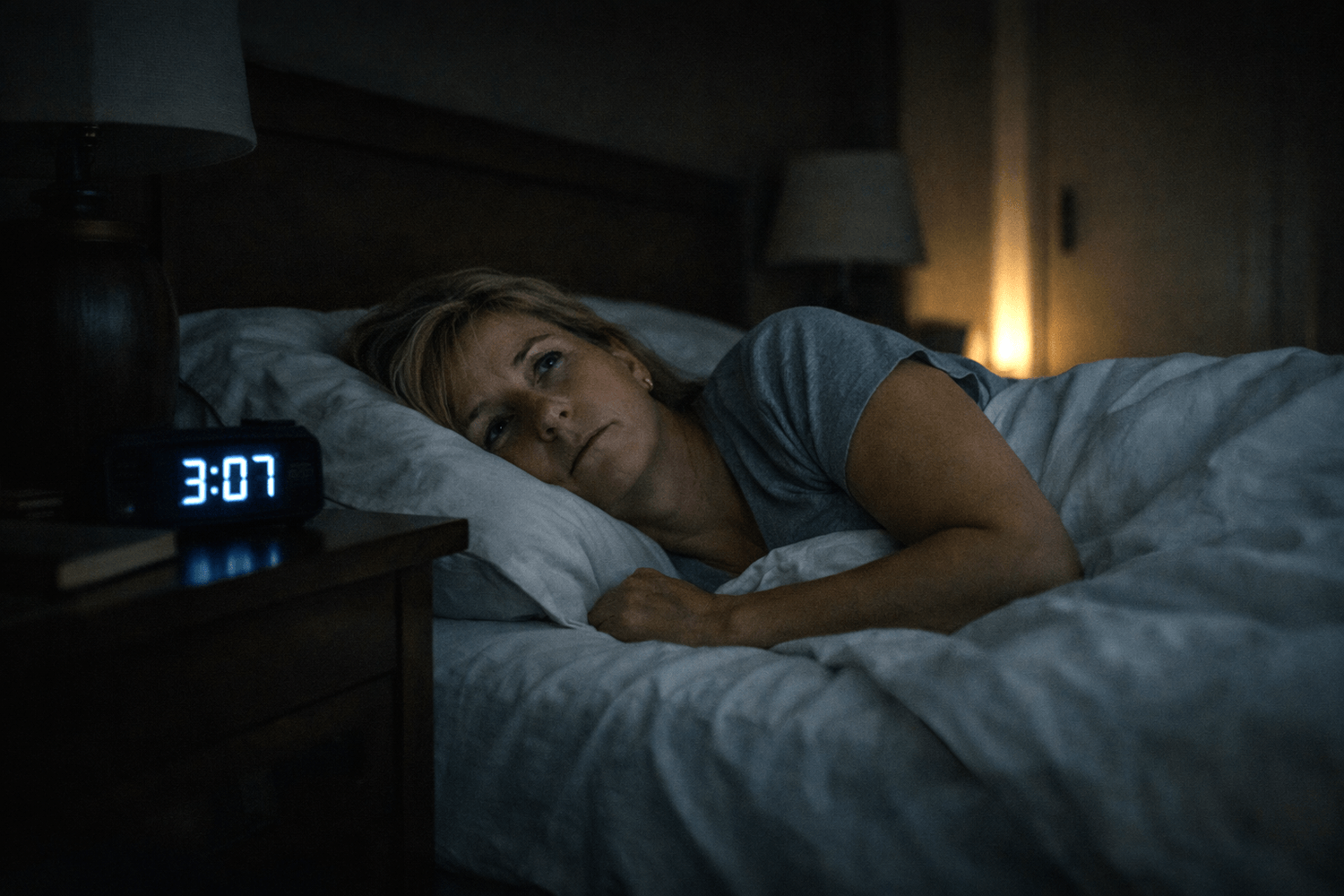
Why 3am Feels Personal. Because It Is.
If you're a woman over 50 and you reliably wake somewhere around 3am and can't get back to sleep, you're not imagining it and you're not alone. There's a real reason it happens at that hour, and it gets more stubborn after menopause.
Here's the short version.
Your body's stress hormone starts rising around 3am. That's just how your circadian rhythm works. As it rises, you become easier to wake fully. A sound, a thought, a slight temperature change that wouldn't have touched you at midnight can pull you clean out of sleep at 3:40am.
Progesterone was your natural sleep aid. Before menopause, it helped keep you in deeper sleep through the second half of the night, which is exactly when 3am sits. After menopause, that buffer goes with it.
Estrogen plays a role too. Lower levels have been independently linked to more nighttime awakenings, separate from hot flashes or mood changes.
The tips in this guide that protect your sleep hormones, like keeping your phone away from the bed and getting outside in the morning, become even more important once you understand the extra pressure your body is already working against at this stage of life.
I'm not a doctor, and this isn't medical advice. For anyone who wants the full picture, including what a doctor would actually discuss with you about hormone options, Dr Jen Ashton at Ajenda has written the clearest breakdown I've found. [17]
Sources
[1] Eastman CI et al. Phase advancing human circadian rhythms with morning bright light. PMC, 2015. pmc.ncbi.nlm.nih.gov/articles/PMC4344919
[2] Ko Y, Lee JY. Effects of feet warming using bed socks on sleep quality. Journal of Physiological Anthropology, 2018. pubmed.ncbi.nlm.nih.gov/29699592
[3] Haghayegh S et al. Before-bedtime passive body heating by warm shower or bath to improve sleep: a systematic review and meta-analysis. Sleep Medicine Reviews, 2019. Summarised by the Sleep Foundation at sleepfoundation.org/sleep-hygiene/shower-before-bed
[5] Harvey AG. A cognitive model of insomnia. Behavior Research and Therapy, 2002. Underpins most CBT-I approaches to pre-sleep cognitive arousal.
[6] Systematic review on blue light exposure and circadian rhythm disruption. Chronobiology in Medicine, 2026. chronobiologyinmedicine.org
[7] Efficacy of blue-light blocking glasses on actigraphic sleep outcomes: a systematic review and meta-analysis of randomised controlled trials. Frontiers in Neurology, 2025. frontiersin.org
[8] Schuster J, Cycelskij I, Lopresti A, Hahn A. Magnesium bisglycinate supplementation in healthy adults reporting poor sleep: a randomized, placebo-controlled trial. Nature and Science of Sleep, 2025. pmc.ncbi.nlm.nih.gov/articles/PMC12412596
[9] Ding L, Chen B, Dai Y, Li Y. A meta-analysis of the first-night effect in healthy individuals for the full age spectrum. Sleep Medicine, 2022. pubmed.ncbi.nlm.nih.gov/34998093
[10] Tamaki M, Bang JW, Watanabe T, Sasaki Y. Night watch in one brain hemisphere during sleep associated with the first-night effect in humans. Current Biology, 2016. pubmed.ncbi.nlm.nih.gov/27112296
[11] Same meta-analysis as source 9. The effect was found to be mildest in the 20s and more pronounced in childhood and older adulthood, not a steady age-related decline.
[12] Research on the cortisol awakening response and morning light exposure. Multiple sources including Frontiers in Neuroscience, 2022, and a 2012 study by Rea, Figueiro, Sharkey and Carskadon. pmc.ncbi.nlm.nih.gov/articles/PMC3485507
[14] Ghaly M, Teplitz D. The biologic effects of grounding the human body during sleep as measured by cortisol levels and subjective reporting of sleep, pain, and stress. Journal of Alternative and Complementary Medicine, 2004. pubmed.ncbi.nlm.nih.gov/15650465. Pilot study, 12 participants, 8 weeks.
[15] Nocturia management guidelines, including fluid timing recommendations. NCBI StatPearls, National Institutes of Health. ncbi.nlm.nih.gov/books/NBK518987
[16] Cross-sectional study on evening fluid intake and sleep quality in healthy adults. Sleep Science and Practice, Springer Nature, 2026. link.springer.com/article/10.1186/s41606-025-00169-0
[17] Dr. Jennifer Ashton, MD. "Why You Wake Up at 3 AM." Ajenda (free newsletter), joinajenda.com. Dr. Ashton is a double board-certified OB-GYN and Obesity Medicine physician and former Chief Medical Correspondent for ABC News. This article covers the five biological mechanisms behind the 3am wake-up pattern in women, including cortisol rhythm, thermoregulation, progesterone loss, estrogen and sleep architecture, and lighter sleep staging in the second half of the night. Sign up free at joinajenda.com.
[18] Laborde S, Hosang T, Mosley E, Dosseville F. Influence of a 30-day slow-paced breathing intervention compared to social media use on subjective sleep quality and cardiac vagal activity. Journal of Clinical Medicine, 2019. pmc.ncbi.nlm.nih.gov/articles/PMC6406675
[19] Differences in risk aversion between young and older adults. PMC. pmc.ncbi.nlm.nih.gov/articles/PMC3852157. Older adults were found to be measurably more risk averse than younger adults in controlled decision-making tasks.
[20] Multiple sources on meal timing and sleep, including a cross-sectional survey of meal proximity to bedtime (PMC, ncbi.nlm.nih.gov/pmc/articles/PMC7215804) and Sleep Foundation guidance on eating before bed (sleepfoundation.org/nutrition/is-it-bad-to-eat-before-bed).
[26] ★ Strongest grounding evidence: A randomized, double-blind, placebo-controlled study on the improvement of sleep quality with an Earthing mat. Environmental Health, ScienceDirect, 2025. This is the most rigorous study currently available on grounding and sleep. sciencedirect.com/science/article/pii/S2212958825000059
[21] Digdon N, Koble A. Effects of constructive worry, imagery distraction, and gratitude interventions on sleep quality: a pilot trial. Applied Psychology: Health and Well-Being, 2011.
[22] Jackowska M et al. The impact of a brief gratitude intervention on subjective well-being, biology and sleep. Health Psychology, 2016. A two-week gratitude journaling intervention was associated with improved sleep quality, reduced time to fall asleep, and increased sleep duration.
[23] Travel insomnia and travel fatigue, including the role of planning, navigation and anticipation in raising cortisol and adrenaline. Clayton Sleep Institute. claytonsleep.com
[24] Cultural differences in mattress firmness preference and the link between mattress discomfort and disrupted sleep continuity. Mattress Miracle and PMC research on mattress firmness and sleep quality. pmc.ncbi.nlm.nih.gov/articles/PMC12071755
[25] Ambient temperature and sleep quality, including the narrow optimal range for sleep and the effects of heat and cold on sleep fragmentation. Multiple sources including a systematic review of ambient heat and sleep, ScienceDirect, and a field study of thermal adaptive behaviours in tropical climates. sciencedirect.com/science/article/pii/S1087079224000194